

The deadline is not a quantum-computer launch date
Encryption can feel permanent because it works invisibly. Yet some of the public-key algorithms that secure digital communications are based on mathematical problems that a sufficiently capable quantum computer could solve much faster than a classical computer. The risk is that information protected today may remain valuable long after the systems protecting it have become vulnerable. That is why post-quantum cryptography (PQC) is a present-day planning issue, even though a cryptanalytically relevant quantum computer does not yet exist.
The National Institute of Standards and Technology (NIST) published its final transition roadmap, NISTIR 8547, on 27 October 2026. It describes how organizations should move away from quantum-vulnerable public-key standards toward quantum-resistant key-establishment and digital-signature standards. NIST emphasizes that migration effort differs by use case; a single deadline or one-for-one software upgrade will not fit every environment. [1] The useful enterprise question is therefore not “When will quantum arrive?” but “How long would our data, identities and systems need to remain trustworthy, and how difficult will it be to replace the cryptography they depend on?”
Table of Contents
Understand what is actually at risk
PQC is often described as a replacement for encryption, but the most urgent transition concerns public-key cryptography. These algorithms appear in secure web connections, remote access, certificates, software updates, identity infrastructure, code signing, secure email, hardware devices and third-party services. Symmetric encryption, such as AES, is not affected in the same way; the migration discussion is not a reason to switch every cryptographic component indiscriminately.
NIST’s first principal PQC standards include ML-KEM for key establishment and ML-DSA and SLH-DSA for digital signatures. Their availability does not mean an organization should simply select an algorithm and deploy it everywhere. Compatibility, implementation maturity, key sizes, performance, protocol support, validation and vendor readiness all matter. [2] A good roadmap starts with understanding where vulnerable public-key algorithms are used and what business process each use protects.
Start with a cryptographic inventory
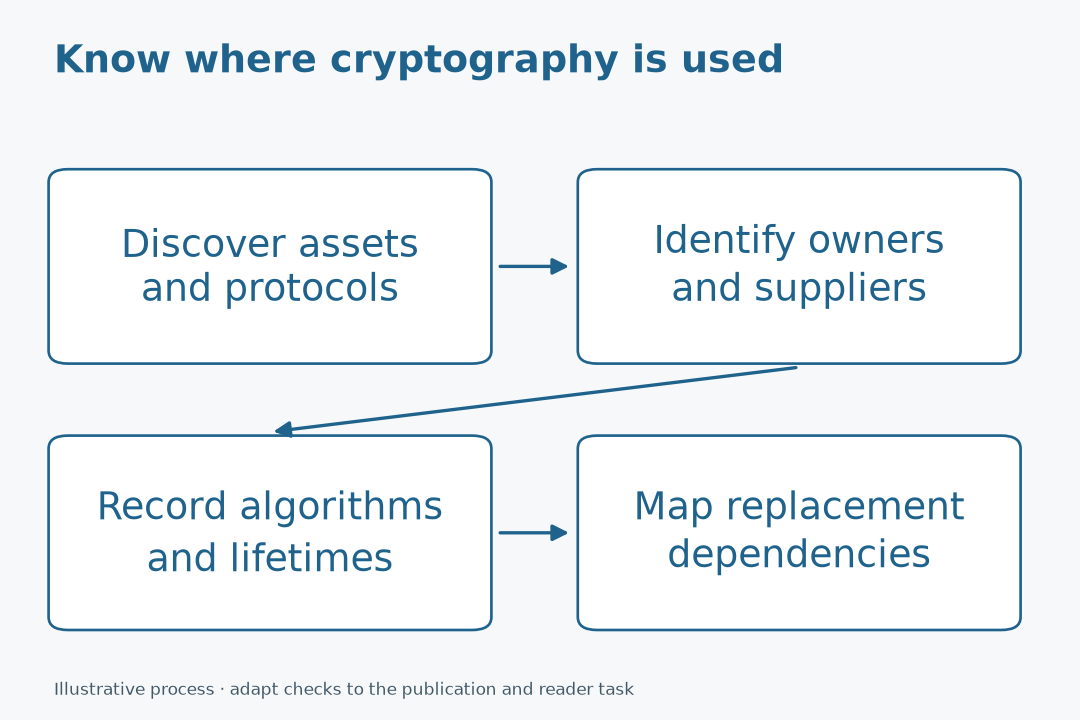
Most organizations cannot answer a basic question: where, exactly, do we use RSA, elliptic-curve cryptography or other public-key algorithms? Some uses are hidden inside application libraries, identity providers, network appliances, mobile apps, industrial controllers, cloud services, build pipelines and managed service contracts. Certificates may also be embedded in devices that are difficult to update after deployment.
Build an inventory that connects each cryptographic dependency to an owner, asset, business service, supplier, algorithm, protocol, certificate authority, key lifecycle and planned replacement route. Automated discovery tools can help scan endpoints and network traffic, but they will not reveal every dependency. NIST’s National Cybersecurity Center of Excellence is demonstrating cryptographic discovery and inventory approaches as part of its migration project. [3] Treat the inventory as a living operational record, not a one-time spreadsheet created for an audit.
Prioritize by data lifetime and replacement difficulty
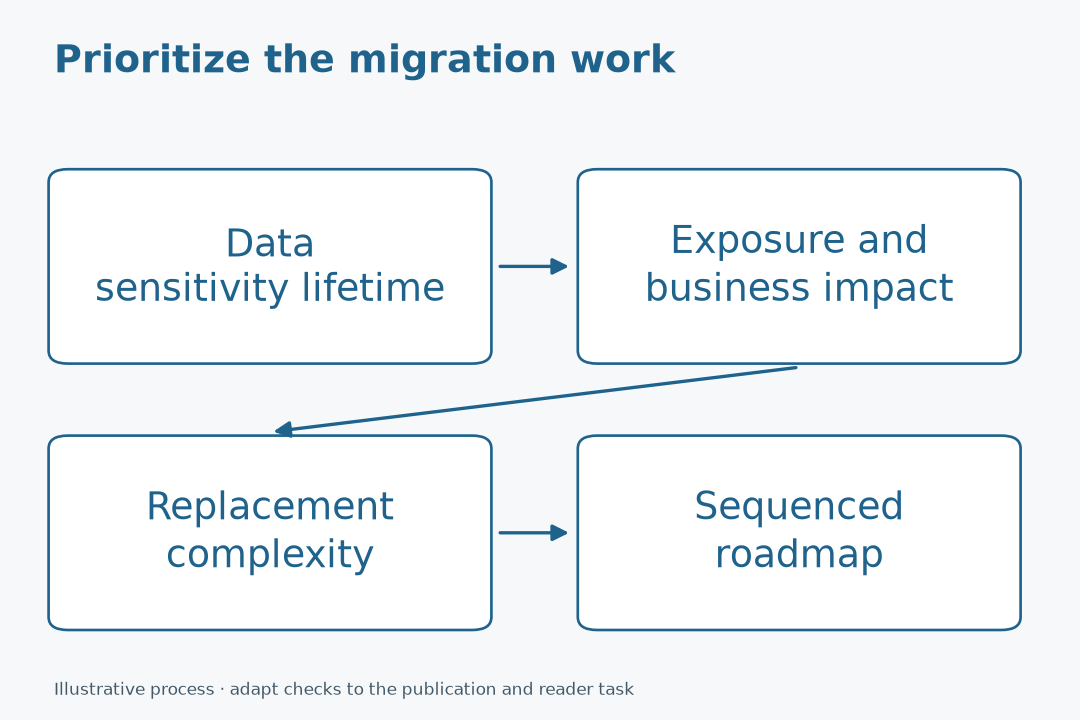
A practical risk model should combine four dimensions. First, assess confidentiality lifetime: would a stolen record still be sensitive in ten or twenty years? Second, assess exposure: is the system externally accessible, widely connected or handling high-value data? Third, assess migration complexity: can the software be updated centrally, or is it embedded in equipment with a long replacement cycle? Fourth, assess business impact: would a failed certificate, signature or secure connection interrupt a critical operation?
This model helps teams avoid two common mistakes. One is migrating only easy systems while leaving long-lived sensitive information exposed. Another is buying a product labelled ‘quantum-safe’ without understanding which algorithms it uses, how it handles keys, or whether it interoperates with the rest of the environment. CISA, NSA and NIST have urged inventories, risk assessments, vendor engagement and roadmaps partly because of the ‘harvest now, decrypt later’ threat: adversaries may collect encrypted information today and attempt to decrypt it in the future. [4] Prioritization should reflect the value and shelf life of information, not headlines about quantum hardware.
Build crypto agility before changing everything
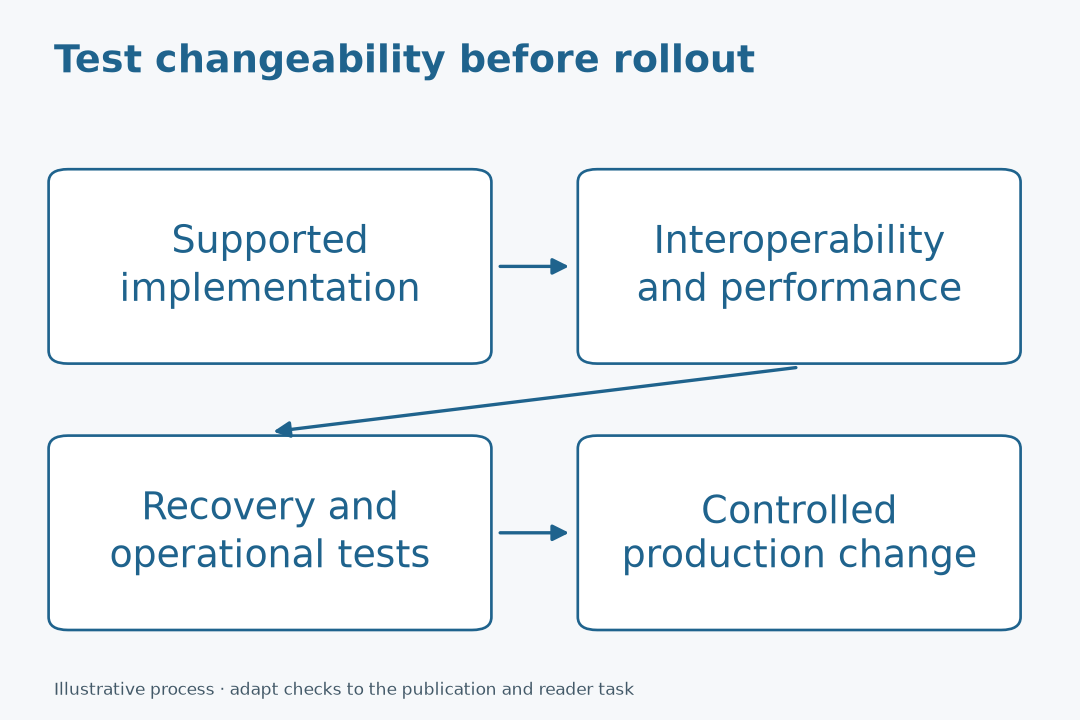
Crypto agility is the ability to change cryptographic algorithms, parameters and providers without redesigning an entire application or business process. It depends on good engineering choices: centralized policy, replaceable cryptographic libraries, documented protocol dependencies, managed certificates and keys, and tested mechanisms for algorithm negotiation. It also requires teams to know where cryptographic decisions are hard-coded.
Design for agility does not mean allowing applications to accept any algorithm. Security teams should define approved profiles and reject downgrade paths that silently return systems to weaker settings. During transition, hybrid approaches may be considered where standards bodies and protocol specifications support them, but hybrid configuration must be implemented and tested carefully. Performance testing is important too: post-quantum keys and signatures can be larger, and network appliances, constrained devices or high-volume services may behave differently under load. The NIST migration project specifically examines implementation, interoperability and performance questions. [3]
Make vendors part of the migration plan
A company may control its application code but not the cryptographic implementation in its cloud platform, payroll service, payment gateway, identity provider or industrial equipment. Procurement teams should ask suppliers for a documented PQC roadmap, supported standards, product upgrade paths, testing status, certificate and key-management plans, end-of-support dates and a clear explanation of who is responsible for migration. Contract renewals are a useful point to require evidence rather than accepting general assurances.
Prioritize suppliers that sit on trust boundaries: certificate authorities, identity services, managed network providers, code-signing services, backup platforms and providers holding sensitive long-term records. A vendor statement that it is “quantum ready” should be translated into specific questions: Which functions are protected? How are customers notified when cryptographic components change?
A practical post-quantum cryptography migration sequence
A staged programme is easier to govern than a big-bang change. In the discovery phase, appoint a senior sponsor and a cross-functional lead spanning security, infrastructure, architecture, procurement, legal, records management and product teams. Record exceptions and owners.
In the design phase, map each priority use case to approved PQC standards and identify dependencies in protocols, certificates, hardware and suppliers. In the pilot phase, test representative workloads: external TLS, internal service-to-service connections, code signing, device identity and long-lived archives. In the deployment phase, update one service class at a time, maintain rollback controls that do not reintroduce unacceptable risk, and monitor errors and negotiation failures. A migration is not complete because a new option exists; it is complete when vulnerable paths are retired or formally risk-accepted.
Illustrative scenario: the forgotten certificate chain
Consider a manufacturer that has migrated its public website to a new cryptographic configuration but has not reviewed its connected devices. A fleet of industrial sensors uses certificates issued years earlier by an embedded device identity service. The devices cannot easily be patched in the field, and the supplier has not published a clear upgrade path. Meanwhile, the company stores product telemetry and maintenance histories that may need confidentiality for many years.
A cryptographic inventory exposes the dependency. The company classifies telemetry by sensitivity and retention period, asks the supplier for an update plan, and tests new device models with a PQC-ready certificate workflow. For deployed devices, it plans a staged replacement or gateway strategy and documents residual risk. The lesson is that product lifetimes can outlast cryptographic assumptions, so procurement and lifecycle planning must include upgradeability.
Govern it as infrastructure modernization
Track critical applications inventoried, unowned dependencies, high-risk systems with approved plans, supplier coverage, tested profiles and unsupported devices with funded retirement paths. Review exceptions through enterprise risk governance and link the inventory to architecture and change management.
NISTIR 8547 is guidance, not a universal private-sector legal deadline; U.S. federal milestones apply to specified federal systems. Other organizations must assess their own jurisdictions and contracts. Waiting for a breakthrough leaves too little time to replace critical dependencies.
Frequently Asked Questions
Does post-quantum cryptography mean quantum computers can already break today’s encryption?
No. A cryptanalytically relevant quantum computer capable of breaking widely used public-key systems is not currently available. The migration is proactive because sensitive data can be harvested now and targeted later.
Do organizations need to replace all encryption?
No. The most urgent work concerns vulnerable public-key algorithms used for key establishment and digital signatures. Symmetric algorithms and hash functions require separate assessment, not indiscriminate replacement.
Which NIST post-quantum standards should enterprises know?
The principal standards include ML-KEM (FIPS 203) for key establishment, ML-DSA (FIPS 204) and SLH-DSA (FIPS 205) for digital signatures. Select implementations based on use case and current guidance.
What is a cryptographic inventory?
It is a maintained record of algorithms, protocols, certificates, keys, libraries, devices, services, suppliers and owners that shows where cryptography is used and how each dependency can be updated.
What does crypto agility mean?
It is the ability to change approved cryptographic algorithms and implementations with controlled effort, without rebuilding every application or accepting insecure downgrade options.
How should a company start if it has limited resources?
Begin with an executive sponsor, a scoped inventory of critical systems, a risk ranking based on data lifetime and system exposure, and direct questions to major technology suppliers about their PQC roadmaps.
Explore our Technology coverage for more enterprise technology insights.
References and Further Reading
[1] NIST, Transition to Post-Quantum Cryptography Standards (NISTIR 8547), 27 October 2026
[2] NIST, Post-Quantum Cryptography Project and FIPS 203/204/205
[3] NIST NCCoE, Migration to Post-Quantum Cryptography
[4] CISA, NSA and NIST, Quantum-Readiness: Migration to Post-Quantum Cryptography